
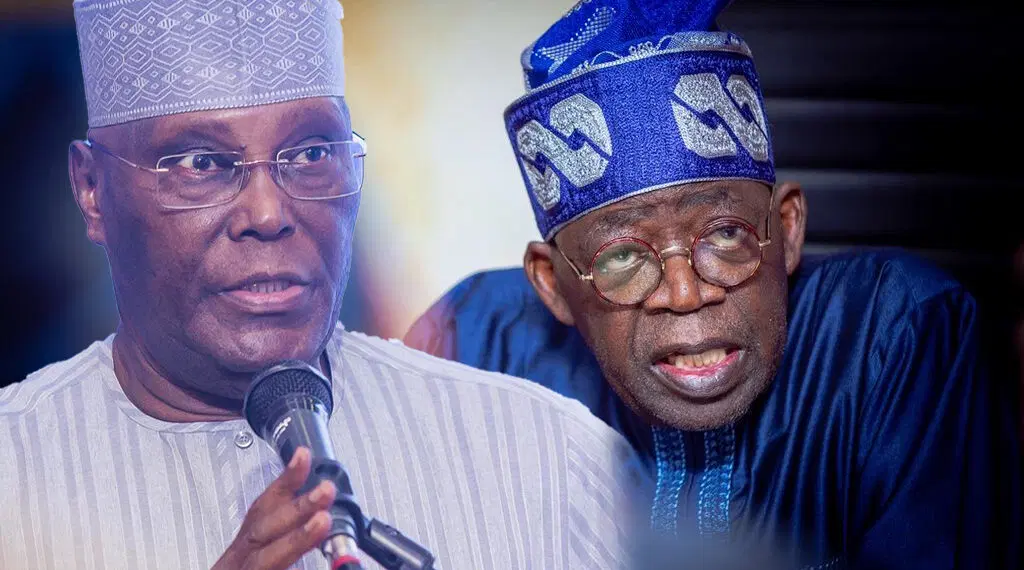
ABUJA — President Bola Tinubu, and former Vice President and presidential candidate of the African Democratic Congress, ADC, Atiku Abubakar, yesterday, disagreed over the return of fuel subsidy.
While Tinubu said Atiku was demonstrating ignorance about governance and the economy in his call, Atiku, who unveiled a new petroleum subsidy model, proposed to replace Nigeria’s old import-subsidy system with a targeted, capped and independently audited production subsidy for domestic refineries.
While receiving Governor Ademola Adeleke of Osun State at the Presidential Villa, Abuja, yesterday, Tinubu argued that one of his opponents’ call to return to subsidy reflected serious ignorance about governance and the economy, recalling that before his administration, 27 states were unable to pay salaries, let alone pensioners, and that some governors had come to the Federal Government unable to function on their own.
The President said ordinary people and their families now feel the impact of government through the provision of infrastructure such as good road networks, housing, school rehabilitation, hospital and healthcare resuscitation, and the training of teachers and health workers to protect vulnerable families. He said the people of fortunate states pronounce their judgment on their leaders through their support, and urged Adeleke to embrace unity and avoid making political opponents victims of his campaign.
President Tinubu advised the governor to build a network of unity and unified tools for governance, stressing that winning an election was the essence of democracy rather than conquering anyone. He expressed happiness over the reconciliatory conversation and urged the governor to expand his reach as a way of showing gratitude to the people, not merely through celebration but through action. He described his own position, and Adeleke’s, as the outcome of divine will and the support of the people rather than personal cleverness, and urged the governor to use his unique position to promote unity, peace and stability, avoid stigmatising opponents, and continue with the progressive instincts and mobilisation that had brought him success.
Speaking to journalists, the Osun State governor thanked the President, describing him as the father of the nation who fought for democracy and ensured a free and fair election, and pledged to work towards sustaining democracy in Nigeria.
Atiku unveils new subsidy model
Atiku, in a statement by his Senior Special Assistant on Public Communication, Phrank Shaibu, said the Economic Recovery Plan AERP 2027 would shift subsidy support away from fuel importation towards local refining.
He argued that the real choice facing Nigeria is not between subsidy and no subsidy, but between an opaque system that breeds waste and a disciplined one that delivers measurable benefits. He explained that the plan would move subsidy from importation to production, from middlemen to Nigerian refineries, and from unverifiable claims to verifiable barrels, describing the guiding principle as ensuring that the subsidy follows the barrel.
Under the plan, qualifying refineries would get domestic crude at a preferential price, but only in exchange for verified production and guaranteed local supply. According to him, every subsidised barrel would be tracked from allocation through refining to delivery, with crude intake, yields and inventories reconciled to rule out the kind of phantom cargoes and unverifiable claims that plagued the old regime. He said operators who divert products, falsify records or fail to pass on the benefit to consumers would lose eligibility, refund the subsidy and face prosecution.
The former vice president added that allocation itself would be rules-based and open to both public and private refineries, to prevent the programme from becoming a vehicle for enriching politically connected operators.
Central to the proposal, he said, was fiscal discipline, adding that the subsidy would run within a fixed annual ceiling approved by the National Assembly, with independent auditors verifying output against spending. He described it as a deliberate break from a subsidy regime that has historically produced open-ended, unbudgeted liabilities, adding that support per barrel would shrink over time as local refining capacity grows, built around a statutory sunset clause, with the ultimate goal being to build a refining industry strong enough to eventually not need subsidy.
Atiku also renewed his attack on the Tinubu administration’s handling of subsidy removal, questioning what exactly disappeared when the president declared subsidy was gone at his inauguration in May 2023, given that NNPC Limited’s audited accounts still recorded roughly N4.84 trillion in “Energy Security Expenses” in 2023 and N7.13 trillion in 2024. He argued that Nigerians could not be made to pay for subsidy removal twice, once through punishing pump prices and again through unexplained subsidy-like costs against their commonwealth, contrasting Tinubu’s approach of announcing first and explaining later with his own proposed approach of defining the intervention, establishing the ceiling, appropriating the money, tracking the crude, verifying production, guaranteeing consumer benefit, publishing accounts and progressively reducing the subsidy.
Atiku is a hypocrite, renegade —Presidency
However, the Presidency also took a swipe at Atiku Abubakar’s promise to restore petrol subsidies if elected President in 2027.
The Presidency, in a statement by Special Adviser to the President on Information and Strategy, Bayo Onanuga, said that rather than offering a creative alternative to the Tinubu administration’s programme, Atiku had suggested restoring what it described as the abused, wasteful, pillaged and corruption-ridden fuel subsidy regime, which the Petroleum Industry Act had made illegal from the end of June 2023.
The statement noted that Atiku had previously believed the subsidy regime should be eliminated, a position he had canvassed ahead of his defeat in the 2023 election, but accused him of opportunistically recanting that stance and turning against his own economic doctrine. It suggested that Atiku, desperate for power just months before the election, had made a promise that did not make fiscal sense and was against the genuine interest of the people.
The Presidency sought to clarify what it described as ambiguities about the so-called subsidy, explaining that it was not money sitting in the treasury for distribution but rather the discount NNPC offered by selling fuel below cost, leading to under-recovery and massive losses. It disputed Atiku’s claim of an existing N30 trillion subsidy windfall, saying no such savings existed outside of his imagination, and argued that restoring the old arrangement would require a clear legal, fiscal and administrative framework, including identifying funding sources and determining implementation under the current petroleum-market structure.
The statement added that Nigeria could not afford to return to policies whose costs were hidden from citizens until they resurfaced as debt, reduced social spending, or pressure on the national currency, while welcoming debate on the cost of living provided it was anchored in Nigeria’s present economic reality rather than that of the past.
