
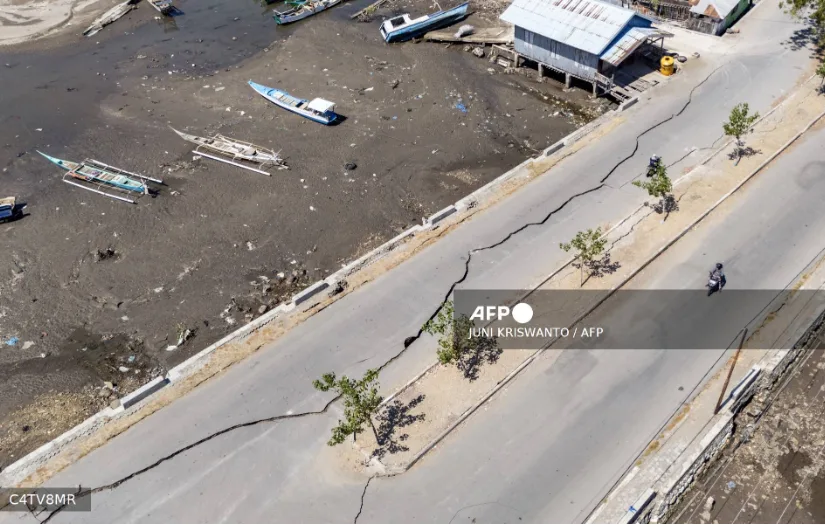
Thousands of people displaced by a powerful earthquake in eastern Indonesia awaited aid Monday as they camped out at schools, police stations and government offices.
The 7.7-magnitude quake early on Saturday killed 54 people and injured more than 100. Rescue officials have said there were no reports of people missing.
The number of people unable to return to their homes had risen to 12,800 by Monday morning, dispersed among several towns on Flores island, Berton Suar Pelita Panjaitan, spokesman for Indonesia’s BNPB national disaster agency, told AFP.
Many Flores inhabitants were preparing to sleep outside for a third night, afraid to go home as over 1,600 aftershocks rumbled through the area, according to the BMKG geological agency.
AFP saw several residents of the small town of Mbay, in Nagekeo regency nearest the epicentre, camped out in makeshift tents they had erected using tarpaulins and poles. Mbay resident Junaidin, 32, explained that homes in the area were no longer liveable, since many had collapsed or were riddled with cracks, forcing residents to only return briefly for water, clothes and pillows before spending nights outside.
Many Flores residents have traumatic memories of another 7.7-magnitude quake that hit the island in 1992, triggering a tsunami and killing about 2,500. Junaidin, who like many Indonesians goes by one name, said residents felt largely on their own, expressing frustration over what he saw as a slow government response even as the nation marked Independence Day with celebrations in Jakarta. He said no government assistance, whether tents, medicine, food or drinking water, had arrived, and appealed to authorities to recognise residents as part of the nation and look after them.
The Indonesian Air Force said it was bringing 13 tonnes of emergency aid in two Hercules planes and a Boeing. It was also deploying helicopters to bring emergency supplies directly to survivors in isolated communities, the Antara state news agency quoted the commander of El Tari Air Base in Kupang as saying. The aid included food, clothes, clean water and emergency medical equipment, with military personnel deployed to help with distribution in key hubs.
For locals, the provisions cannot come soon enough. Mbay resident Siti Saudah Daso, a 31-year-old mother of three, said she had fled with nothing but the clothes on her back, describing herself and others as disaster victims still awaiting help that had been promised but not yet delivered, leaving many feeling upset and disappointed.
Rescuers were still combing the stricken area for victims, search and rescue official Fathur Rahman told AFP, explaining that both land and air operations, including helicopters, were being used, and that although there had been no reports of missing persons, teams were continuing to scour the area to be certain.
The epicentre of the shallow quake was located just off the north coast of Flores, geological authorities said. The affected areas have few, if any, high-rise buildings.
Berton, the disaster agency spokesman, said at least 914 houses on the island were severely damaged and hundreds of others to a lesser degree. Dozens of public buildings, including educational and health facilities as well as government offices, were also affected.
The NGO Save the Children said more than 8,000 children faced safety risks and disruptions to their education following the quake.
Indonesia experiences frequent earthquakes due to its location in the Pacific “Ring of Fire”, an arc of intense seismic activity stretching from Japan through Southeast Asia and across the Pacific basin. A devastating 9.1-magnitude tremor in 2004 struck off the coast of Sumatra and triggered a tsunami that killed 220,000 throughout the region, about 170,000 of them in Indonesia. It was one of the deadliest natural disasters in recorded history.
AFP
