
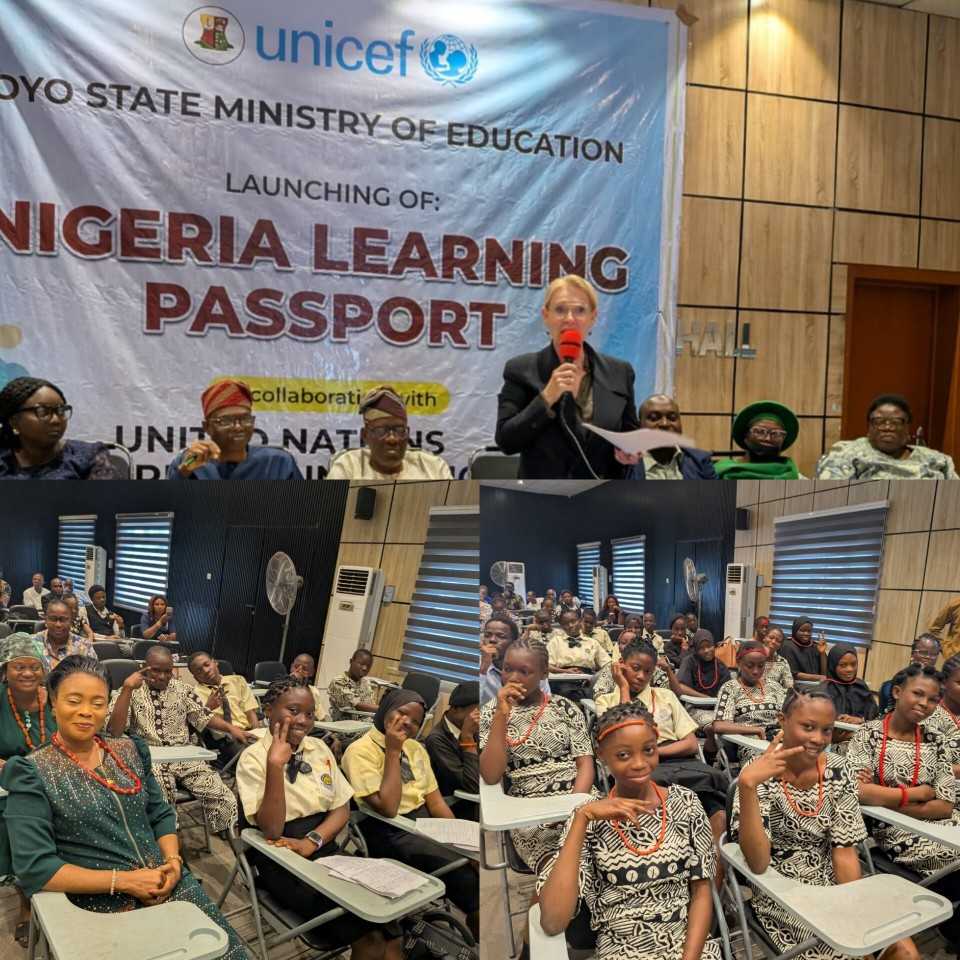
The Oyo State Government has moved to bridge the digital learning gap between children in urban centres and those in rural and underserved communities with the adoption of the Nigeria Learning Passport (NLP).
The initiative, launched in partnership with the United Nations Children’s Fund (UNICEF) at the Local Government Hall, Secretariat, Ibadan, is expected to expand access to curriculum-aligned learning materials for pupils, students and teachers across the state.
With the adoption, Oyo becomes the 26th state in Nigeria to formally embrace the Nigeria Learning Passport, a digital education platform designed to provide learning opportunities beyond the traditional classroom.
UNICEF Lagos Chief of Field Office, Celine Lafoucriere, said the success of the initiative would depend largely on ensuring that children who face the greatest barriers to education were not left behind.
Lafoucriere urged the state government and its partners to deliberately target learners in rural and underserved communities, particularly girls, as the digital learning programme expands.
She said the platform currently had about 2.4 million children and teachers using it across Nigeria, with thousands of lessons available in subjects including Mathematics, English and Science.
According to her, the lessons can be accessed through mobile phones and tablets, both online and offline, making the platform useful even in communities with limited internet connectivity.
She also disclosed that Airtel covers the cost of data usage for the platform, allowing families to access the learning resources without paying for the data.
Lafoucriere said the Nigeria Learning Passport was initially developed in response to the disruption caused by the COVID-19 pandemic, when school closures affected more than 1.6 billion children globally.
She explained that the experience demonstrated the need for education systems to have alternative channels through which children could continue learning during emergencies and other disruptions.
The UNICEF official commended the Oyo State Government for its commitment to education, particularly the recent recruitment of 5,000 teachers, saying the additional personnel would strengthen the capacity of the education system to reach more children.
She, however, stressed the importance of continuous teacher training, noting that new teachers would need adequate support to effectively integrate digital resources into classroom teaching.
The Commissioner for Education, Segun Olayiwola, said the adoption of the platform was part of the state’s broader effort to reposition education in line with the demands of the 21st century.
Olayiwola said rapid technological changes had transformed how people work, communicate, acquire knowledge and solve problems, making it necessary for the education sector to adapt.
He said the state government, through its human capital development agenda, was committed to equipping learners and teachers with the skills required to participate meaningfully in a digital society and economy.
“The world is changing rapidly. Technology is transforming the way we work, communicate, acquire knowledge and solve problems. Education cannot remain outside this transformation,” he said.
The commissioner added that the Nigeria Learning Passport would help extend learning beyond the conventional classroom by providing students and teachers with access to educational resources through digital devices.
Also speaking, the Permanent Secretary, Oyo State Ministry of Education, Science and Technology, Bamidele Oyinloye, described the initiative as another milestone in the state’s efforts to deploy technology and innovation in education.
Oyinloye said the Nigeria Learning Passport should not be seen merely as another digital platform, but as part of a deliberate effort to make learning more accessible, inclusive and flexible for learners and teachers.
