
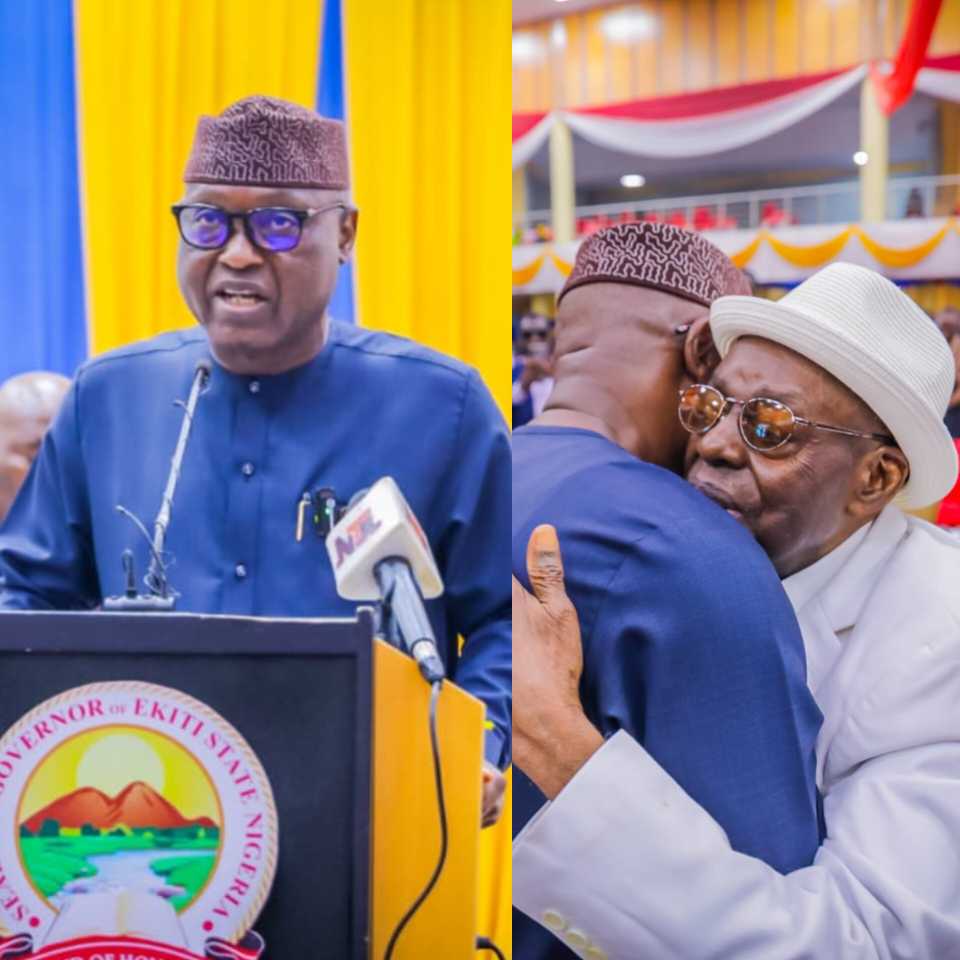
Ekiti State Governor Biodun Oyebanji says the state is benefiting from a deliberate policy of continuity in governance, arguing that lasting legacies depend on succession planning and institutional systems that outlive individual leaders.
Oyebanji spoke on Tuesday while delivering the 2026 Afe Babalola Distinguished Personality Lecture at Afe Babalola University, Ado-Ekiti (ABUAD).
The lecture, themed _“Building Legacies: Governance, Successor-Generation and Continuity,”was organised by ABUAD’s Department of Conflict, Peace and Strategic Studies in honour of the university’s Founder and Chancellor, Aare Afe Babalola, SAN.
Oyebanji said the best way to preserve legacy is to deeply entrench institutional systems that carry on seamlessly even in the absence of pioneers,” Oyebanji said.
He urged leaders to develop “pragmatic succession plans” and enlist “dedicated and capable lieutenants” committed to sustaining and improving a shared vision.
The governor traced his preparation for office to his service under Ekiti’s first elected governor, Otunba Niyi Adebayo, and his immediate predecessor, Dr. Kayode Fayemi.
Oyebanji identified continuity of inherited projects
regardless of the originating administration as the core of his government’s philosophy. He cited the Ekiti Transition Law 2022, which mandates continuation of government projects, as a framework his administration has implemented.
“Each government is a continuation of those before it,” he said. “So, I was committed to the completion of projects started by Chief Segun Oni, Mr. Ayodele Fayose, and my immediate predecessor, Dr. Kayode Fayemi.”
Completed inherited projects listed by the governor include: Ifaki-Iworoko-Ado Ekiti Road; Ekiti Agro-Allied International Cargo Airport; first phase of the Ring Road; the IPP Project; Traditional Council Chambers; Ado-Ekiti Bus Terminal; and RAAMP roads.
He also highlighted projects initiated by his administration: power projects that have improved electricity supply statewide; and road works including GRA III Extension Road, Maryland Road, Oke Ila Road, Agric Olope-Matthew Link Road, Moferere Road, Omisanjana-Ajebamidele Road, Ikole-Ara-Isinbode Road, Omu-Ijelu Road, Ikere-Ise Road, Ikere-Ilawe Road, Ikere-Igbara Odo Road, Ikogosi-Igbara Odo Road, and Itawure-Okemesi Road.
In health and infrastructure, his government is building an 80-bed complex at Ekiti State University Teaching Hospital, overhauling primary and secondary health facilities, and completing the International Centre for Arts and Culture and an Indoor Sports Complex in Ado-Ekiti.
Oyebanji linked these efforts to the Ekiti State Development Plan 2020–2050, a 30-year blueprint aligned with the SDGs, which he said shaped his 2022 campaign manifesto and six-pillar agenda.
The governor described Aare Babalola as “a very distinguished Ekiti elder statesman, an archbishop in the legal temple, a towering national figure and one of the most iconic African achievers of modern era.”
He praised ABUAD’s global standing — recently ranked among the top 100 universities worldwide, 3rd in Africa and 1st in Nigeria by Times Higher Education Impact — and Babalola’s investments in healthcare via ABUAD Multi System Hospital, agriculture, empowerment, and his role in the creation of Ekiti State.
In his response, Aare Babalola called Oyebanji’s lecture one of the best he had heard, describing it as “lucid, stimulating, deep, and capturing key ingredients” on continuity and succession in governance.
He urged the governor to return to ABUAD after public service to share his governance experience with students. Babalola also appealed for intervention on the federal road leading to the institution, citing hardship faced by staff. “Whoever is the contractor working on that road, help us ensure that work is going on day and night,” he said.
