
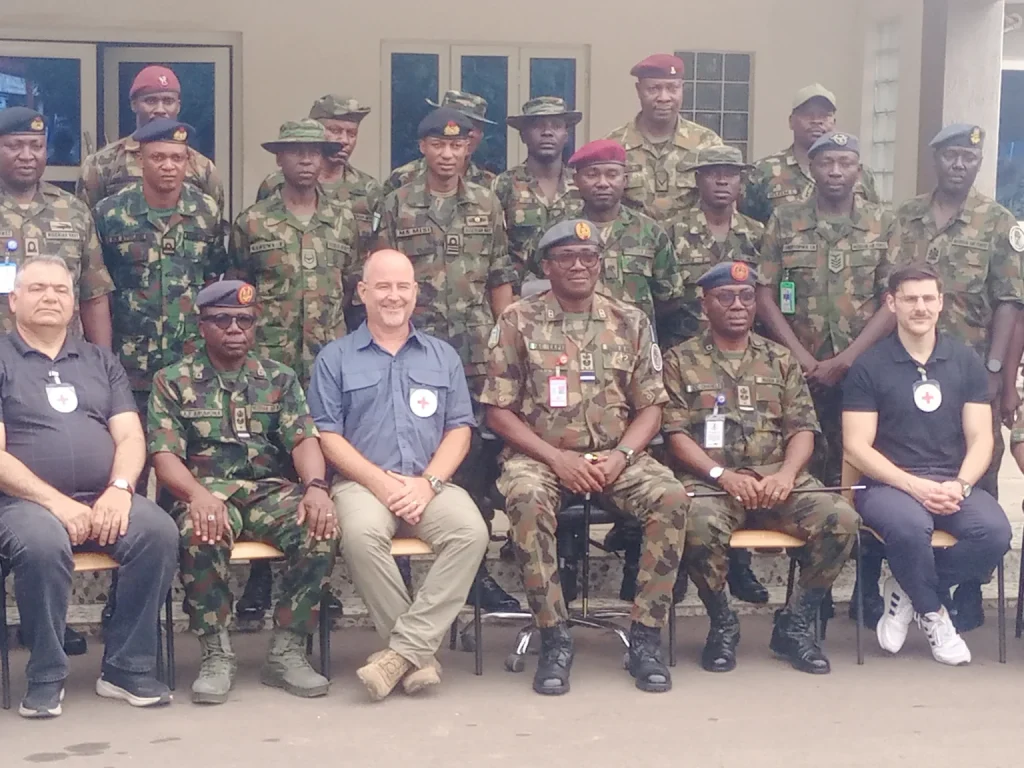
The Defence Headquarters, in partnership with the International Committee of the Red Cross, on Monday launched a specialised Battlefield Mortuary Affairs Programme in Kaduna aimed at improving how soldiers killed in combat are identified, recovered and handled with dignity.
The week-long programme, taking place at the Nigerian Air Force Base, Kaduna, from July 27 to August 1, brings together participants from the Nigerian Army, Nigerian Navy and Nigerian Air Force.
Speaking at the opening ceremony, the Deputy Director of the Defence Identification Centre, Air Commodore Chukwuma Ohanele, described the programme as a landmark initiative aimed at tackling the growing challenges of battlefield deaths amid the rising pace of military operations nationwide.
He explained that the training, developed jointly by the Defence Headquarters and the ICRC, would give participants the knowledge and skills needed for identifying military personnel and handling the remains of the dead with dignity. He noted that as the Armed Forces’ operational tempo increases, battlefield deaths and the difficulties that come with them have become unavoidable, and that experts from both the ICRC and the military would work to address these challenges, stressing that the training was of major importance.
Ohanele further described the management of the dead in conflict situations as more than a technical task, calling it a moral and humanitarian duty. He said the programme had been carefully structured to build the Armed Forces’ capacity in this delicate area, and to ensure troops maintain high standards of professionalism, accountability and respect for human dignity.
He listed the key areas of training to include search and recovery operations, awareness of explosive ordnance disposal, setting up mortuary collection points, preliminary examination of remains, respectful storage, transportation and repatriation of remains, and the establishment of temporary burial sites and cemeteries. He added that participants would also learn about the ICRC’s humanitarian mandate and the legal frameworks guiding battlefield mortuary affairs, including international humanitarian law and Nigerian military doctrine, through a mix of indoor and outdoor exercises along with assessment tests to ensure practical competence.
The deputy director commended the Chief of Defence Staff, General Christopher Gwabin Musa, for approving the programme, and acknowledged the roles played by the Defence Headquarters, the Defence Identification Centre, the Nigerian Air Force School of Medical Sciences and Aviation Medicine, the Regiment Training School and the ICRC in making it possible.
The Commandant of the Nigerian Air Force School of Medical Sciences and Aviation Medicine, Air Vice Marshal Anthony Ekpe, described the training as timely, pointing out that troops are sometimes killed under gruesome circumstances that make identifying their remains or body parts extremely difficult. He said the training would help ensure that at least some fallen personnel could be properly identified, giving their families closure and allowing them to be buried with dignity. He thanked the Defence Headquarters and the ICRC for selecting the institution to host the training and urged participants from all three services to approach the programme with seriousness.
Also speaking, the ICRC’s Forensic Manager, Dr Habib El TaKach, said the programme grew out of discussions that began in Pretoria, South Africa, in 2024. He described it as the first training of its kind, noting that it would improve the identification of soldiers killed in conflict, reduce the number of missing persons, and give families answers about the fate of their loved ones. He explained that the identification process requires careful planning, recovery of remains, transportation and thorough documentation — including photographs, videos and biological samples — all of which are necessary to successfully identify the deceased and bring closure to their families.
The Battlefield Mortuary Affairs Programme is expected to boost the Armed Forces’ operational readiness by embedding internationally recognised standards in the identification, recovery and dignified handling of personnel killed in the course of military duty.
