
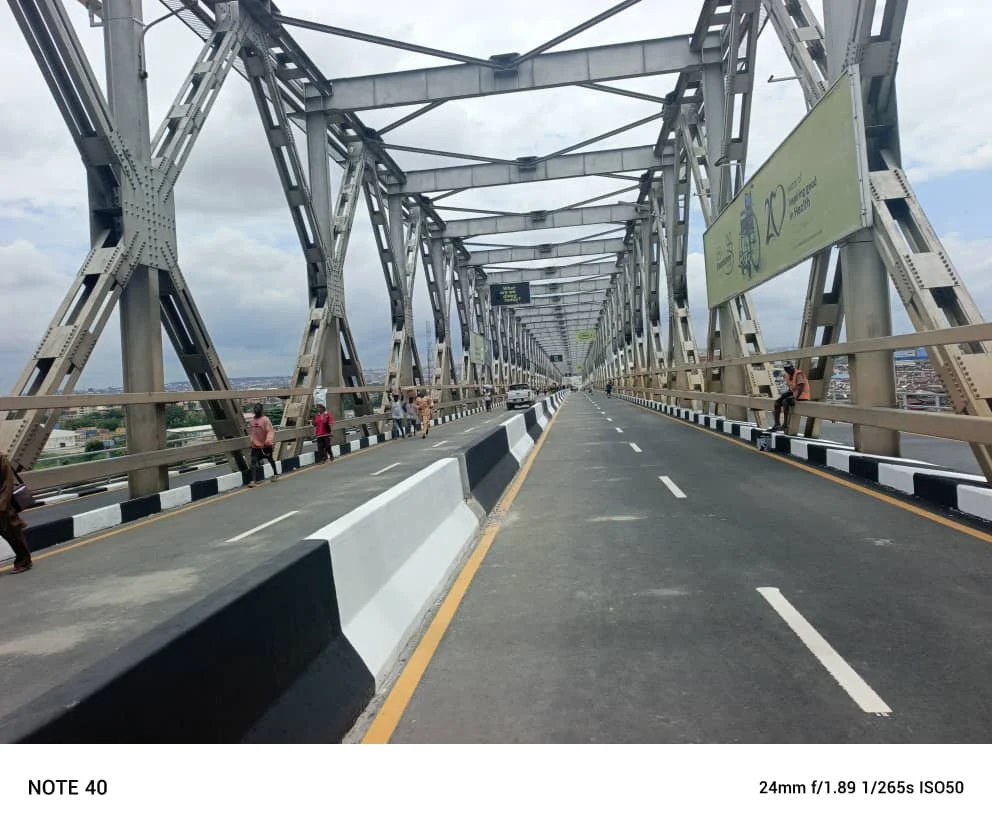
The Federal Ministry of Works has assured commuters and motorists that, barring unforeseen circumstances, the First Niger Bridge may be reopened before the end of this week, as all major construction works have been completed.
The Federal Controller of Works, Anambra State Field Headquarters, Timothy Emenike, made this known in an interview with journalists on Wednesday while clarifying the openings created along the newly installed demarcation on the bridge.
The bridge, which links Onitsha in Anambra State to Asaba in Delta State, was built in 1965. It was closed to traffic from September 7 to 21 for emergency rehabilitation and maintenance after vandalised structural components, including its expansion-joint steelwork, were discovered.
The closure was extended by one week because of persistent rainfall and other unforeseen circumstances. When the Minister of Works, Dave Umahi, inspected the bridge on September 23, he said it would not reopen until major structural rehabilitation had been completed, insisting that the Federal Government would not be stampeded into reopening before critical components were properly repaired.
Our correspondent, who visited the bridge, gathered that the uncertainty over the reopening had increased pressure and anxiety among motorists and commuters diverted to the Second Niger Bridge, leading to longer travel times, higher transportation costs and the burden of navigating dilapidated alternative inner routes.
Emenike said major construction activities, including the tarring of the bridge, had been completed, while the painting of the railings, which began last week, was still ongoing and expected to finish shortly. He said the finishing works indicated that the major rehabilitation had been completed, with some supporting infrastructure and safety installations, such as solar light poles, being finalised before full reopening.
According to him, all works relating to road tarring, asphalt laying, the fixing of expansion bolts and other critical components were done, and the bolts for the solar light poles were being fixed. He said motorists would soon heave a sigh of relief, that the infrastructure needed to ensure free flow of traffic was in place, and that the rehabilitation was aimed at easing traffic and ensuring road users’ safety.
The controller could not say categorically whether photographs of President Bola Tinubu would be installed at the bridge before its reopening, as the minister had directed during his visit. He did, however, reject claims circulating that the newly installed demarcations had been removed or destroyed.
He accused some individuals of spreading fake photographs to discredit the ministry and mislead the public, describing the claim of removal as one of the lies being posted by disgruntled elements. He added that visitors to the bridge could see the demarcations still standing, apart from designated openings created for emergency U-turns.
Findings showed that the anticipated reopening was expected to bring relief to motorists and residents who had faced disruption during the rehabilitation, underscoring the bridge’s importance to commuters and businesses around Onitsha and other parts of Anambra.
An Onitsha resident and motorist, Uche Adieme, said the reopening was significant for road users because the bridge remains an important transport link within and around Onitsha. He said prolonged restrictions had affected daily commuting and put extra pressure on alternative routes.
While the diversion to the Second Niger Bridge had offered an alternative, he said, reopening the rehabilitated crossing would distribute traffic more efficiently and ease the strain of concentrating movements on a few routes. He added that the development carried implications for commercial activity, since Onitsha is a major trading and distribution centre where efficient road connectivity matters for the movement of goods, workers and consumers, and any disruption to major transport links can lengthen travel times and raise logistics costs for businesses.
