
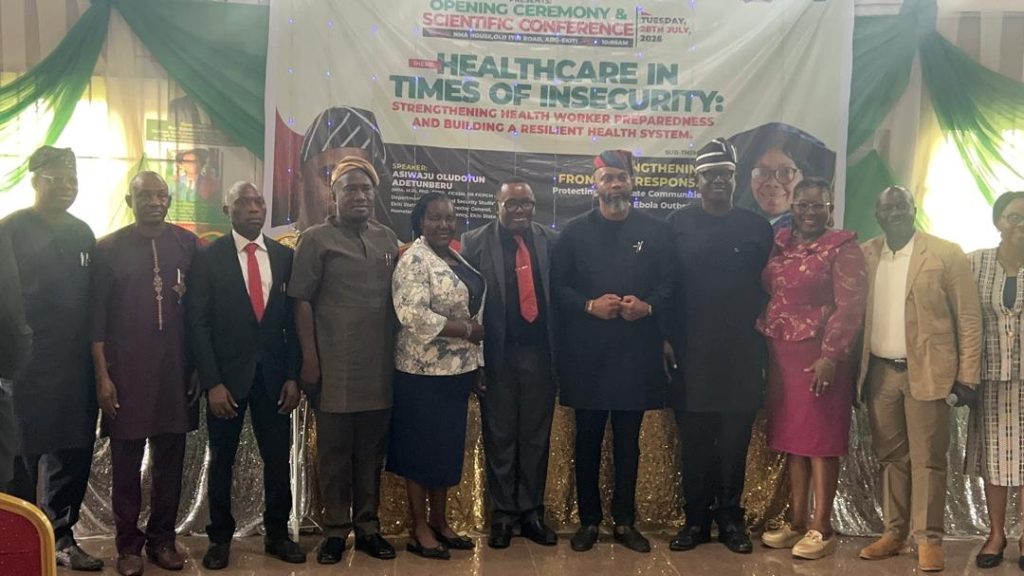
There is need for government at all levels to come up with a more pragmatic policies and actions that will put an end to the current state of insecurity in the country due to its negative impacts on the health sector.
This is one of the key resolutions reached by stakeholders during the opening ceremony of the 2026 Scientific Conference of the Nigeria Medical Association, NMA, held in Ado-Ekiti, with the theme, “Healthcare in Times of Insecurity: Strengthening Health Workers’ Preparedness and Building a Resilient Health System.”
The gathering which comprises medical experts, top government functionaries and scholars also agreed that there must be an improved emergency preparedness and sustained vigilance against Ebola Virus Disease and other possible epidemics.
Delivering the keynote address, DG, Home Land Intelligence Agency Dr. Asiwaju Oludotun Adetunberu said health security had become an integral part of national security, noting that security now extends beyond territorial defence to include human, economic, social, environmental and health security.
He identified terrorism, banditry, kidnapping, farmer-herder conflicts, communal violence, piracy, cybercrime and disease outbreaks as major security challenges affecting healthcare delivery in Nigeria.
According to him, these threats have led to attacks on health facilities and personnel, displacement of communities, disruption of medical services and increased disease outbreaks.
Adetunberu stressed that building a resilient health system requires more than recovering from crises, saying it must be able to anticipate, adapt and learn from emergencies. He identified good governance, effective disease surveillance, adequate funding, a well-trained health workforce, community participation and institutional learning as essential pillars of resilience.
He also urged governments at all levels to strengthen security around health facilities, improve healthcare funding, enforce laws protecting health workers and invest in emergency preparedness, while encouraging healthcare professionals to adhere to safety protocols, report security threats promptly and support disease surveillance and community health education.
Speaking on the sub-theme, “Strengthening Frontline Response: Protecting Ekiti State Communities from Ebola Outbreak,” Prof. Mrs. Eyitope Oluseyi Amu described Ebola Virus Disease as a highly virulent and often fatal zoonotic disease caused by Orthoebolavirus species of the Filoviridae family.
She explained that six strains of the virus have been identified; Zaire, Sudan, Bundibugyo, Taï Forest, Reston and Bombali, with the Zaire strain being the most lethal, recording fatality rates of up to 90 per cent. She recalled major outbreaks across Africa, including the 2014–2016 epidemic in Guinea, Liberia and Sierra Leone, and noted that cases linked to the Bundibugyo strain are still being reported in parts of the Democratic Republic of Congo and Uganda.
Amu said Ekiti State’s response strategy focuses on preventing the importation of Ebola while maintaining rapid response capacity. She disclosed that personal protective equipment has been pre-positioned at the Ekiti State University Teaching Hospital (EKSUTH), the state central store and three zonal stores, while water, sanitation and hygiene facilities have been strengthened and health workers trained on infection prevention and control measures.
She, however, reassured residents that Ekiti State has not recorded any confirmed case of Ebola Virus Disease as of July 2026, while urging sustained vigilance to keep the state free of the disease.
Earlier, the Chairman of the NMA, Ekiti State Branch, Dr. Ifedayo Oreyemi said the program was designed to equip health workers with the knowledge and tools needed to respond effectively to security threats and disease outbreaks.
