
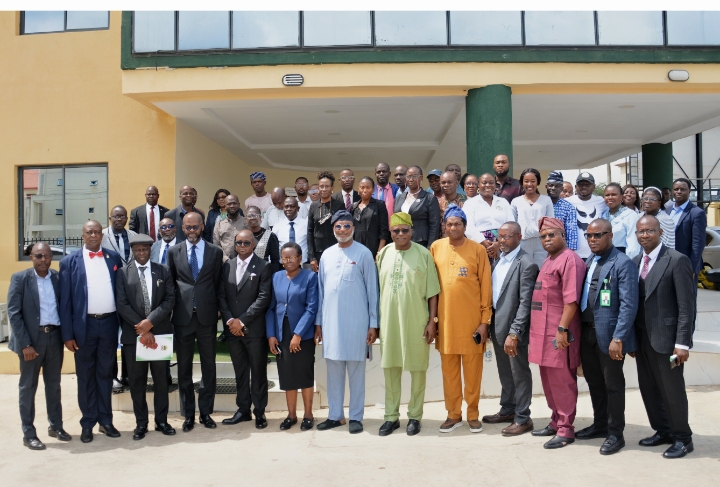
The Ekiti State Internal Revenue Service has committed itself to a continuous review and possible amendment of the State tax laws in order to provide adequate legal safeguards for the Service, the State, and taxpayers.
The Executive Chairman of EKIRS, Mr. Olaniran Olatona, gave the assurance at a two-day training workshop organised for Revenue Court Judges and Magistrates in the State at the Revenue House, Ado-Ekiti.
Mr. Olatona explained that the Service is open to constructive criticism and recommendations from legal luminaries, judicial officers, and other critical stakeholders to address any controversial provisions in the Ekiti State Revenue Administration Law, 2025. He also assured the judiciary of EKIRS’ commitment to a harmonious working relationship with the courts to deepen public trust in tax administration and curb tax offences in the State.
The EKIRS boss, however, warned taxpayers against offences such as obstruction of tax officials in the discharge of their duties, tax evasion, false declarations, document forgery and late filing of returns, among others. He maintained that the Service would not hesitate to invoke the relevant provisions of the law against offenders.
He explained that the workshop was organised to strengthen the legal and institutional framework for sustaining the State’s rising revenue profile without reverting to coercive enforcement measures such as roadblocks and the closure of business premises, while ensuring strict adherence to the provisions of the law.
Hon. Justice Olalekan Olatawura, who spoke on behalf of the Chief Judge of Ekiti State, Hon. Justice Lekan Ogunmoye, expressed satisfaction with the existing relationship between EKIRS and the judiciary. He assured the Service that the judiciary would discharge its responsibilities and provide the necessary support to ensure effective tax administration in the State.
In his presentation titled; “Pre-litigation Dispute Resolution, Burden and Standard of Proof in Tax Disputes,” a facilitator and University of Lagos lecturer, Prof. Abiola Sanni, SAN, said effective tax dispute resolution requires a careful balance between protecting public revenue and safeguarding taxpayers’ rights.
Prof. Sanni recommended sustained training for revenue officers, legal practitioners and judges, alongside timely legislative reviews, as measures to strengthen public confidence in tax administration and promote fair, efficient and credible tax justice.
He urged EKIRS to invest in continuous capacity-building through specialised training for its officers, while encouraging judges to maintain an active interest in developments in tax law, promote consistency in tax adjudication and uphold the applicable statutory provisions.
The commercial law expert also advocated regular reviews of tax legislation to address ambiguities, strengthen procedural safeguards and enhance the effectiveness of tax dispute resolution.
Another facilitator, Mr. Kolawole Abdusalam, who presented a paper titled; “Landmark Cases on Tax Evasion, Tax Avoidance, Tax Assessment Disputes and the Role of the Courts,” described the judiciary as a critical institution in the administration of taxation. While noting that the judiciary must recognise the constitutional and statutory powers of government to impose and collect taxes, he stressed that such powers must be exercised strictly within the confines of the law.
He identified three fundamental principles that should guide judicial intervention in tax matters: taxes must be imposed and assessed in accordance with the law; taxpayers must be accorded fair treatment; and public revenue must be protected by ensuring that taxpayers do not evade legitimate tax obligations through concealment, false declarations or artificial arrangements prohibited by law. Mr. Abdusalam maintained that the judiciary must remain impartial and should neither favour the taxpayer nor the revenue authority.
A former Chairman of the Tax Appeal Tribunal, Lagos Zone 1, Mr. Lanre Lassise-Philips, who spoke on; “Judicial Discretion in Sentencing Tax Offenders, Plea Bargaining and Settlement Frameworks,” stated that effective tax enforcement requires more than assessment and collection.
He explained that it also depends on a credible system for prosecuting tax offences, imposing lawful and proportionate sanctions, resolving disputes in accordance with statutory provisions and safeguarding the integrity of judicial proceedings.
In her presentation titled; “Recovery Through Third Parties,” another facilitator, Miss Josephine Ogbinaka, stressed the importance of subjecting tax laws to judicial interpretation to deepen tax jurisprudence. She challenged EKIRS to ensure that recalcitrant tax offenders were appropriately sanctioned to serve as a deterrent to others.