
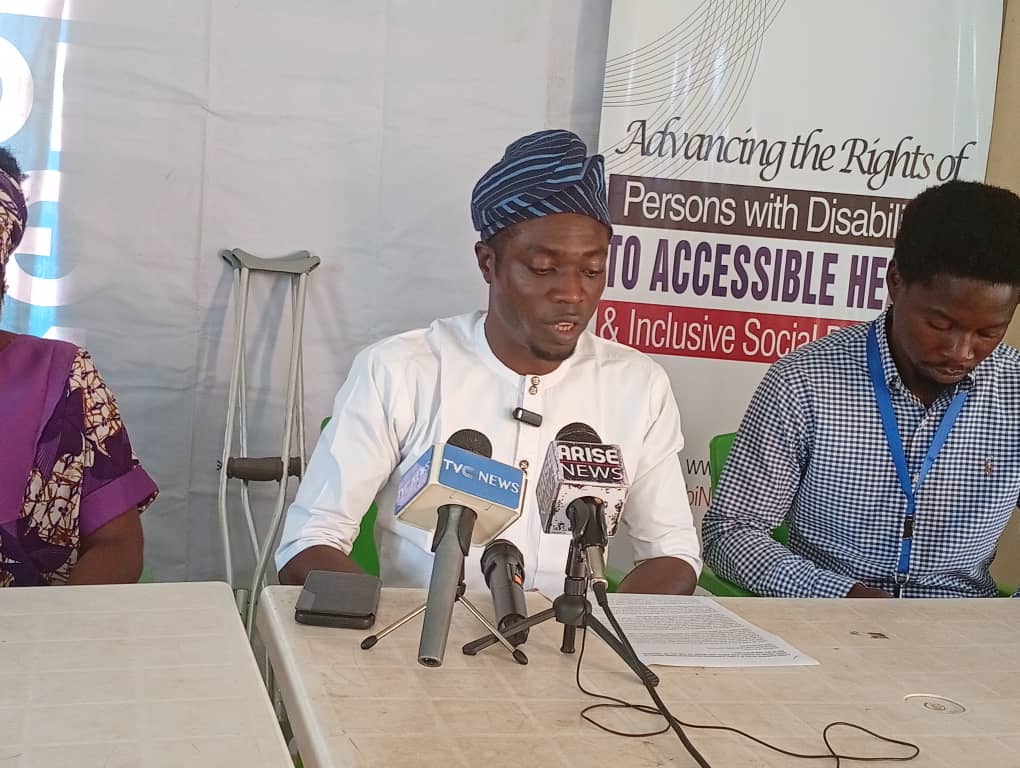
Less than 1% of the combined 2025 budgets of the six Southwestern states has been allocated to disability inclusion, raising serious concerns about government commitment to the welfare and rights of persons with disabilities in the region. This revelation emerged at a press conference organized by Disability Not A Barrier Initiative (DINABI) Nigeria to unveil the ThisAbility Budget (TAB) 2025 Portal and Report, held on Thursday, 19th December 2025, at the Nigeria Union of Journalists (NUJ) Conference Hall.
The event, supported by the Disability Rights Fund (DRF), brought together leaders of the disability community, civil society actors, budget advocates, researchers, and media practitioners. The newly launched TAB Portal is designed to provide public access to disability-specific budget data and analysis, with the aim of strengthening transparency, accountability, and inclusive governance across the six Southwestern states of Nigeria.
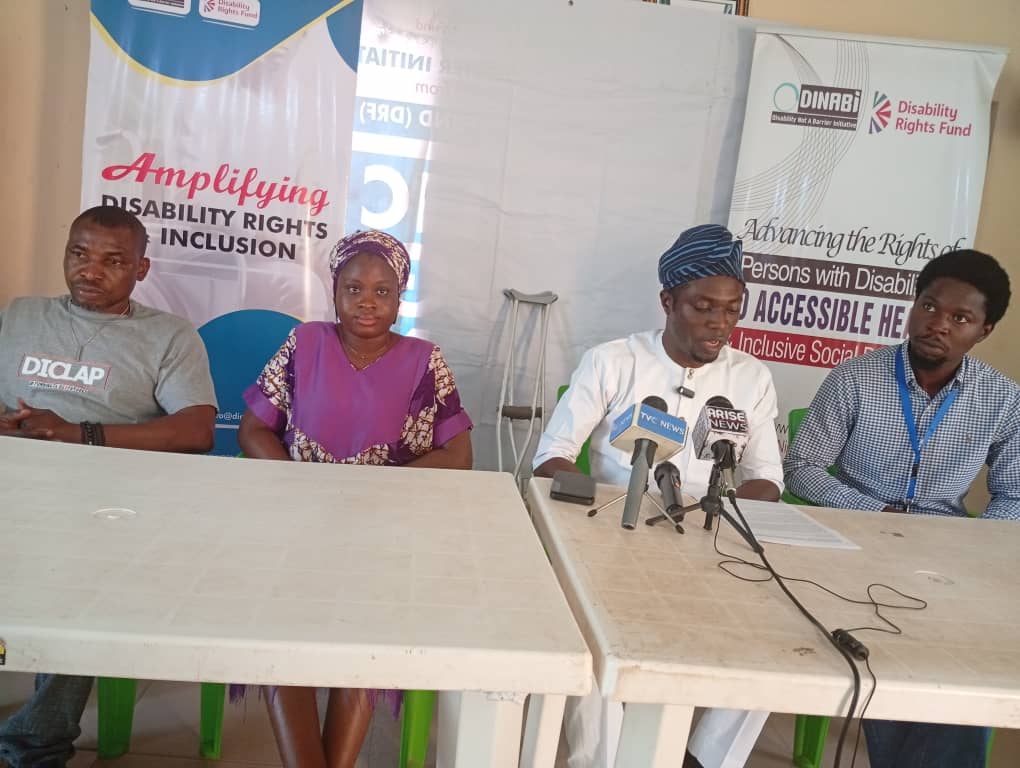
Presenting the findings of the 2025 ThisAbility Budget report, the Executive Director of DINABI Nigeria, Engr. Olajide Funso, expressed concern over what he described as the systematic exclusion of persons with disabilities from state budget processes. He noted that despite persons with disabilities accounting for over 15% of the population, states in the Southwest collectively allocated just 0.048 percent of their total budget of over ₦6.6 trillion to disability inclusion.
According to Engr. Funso, the poor allocation shows weak political will and limited understanding of disability-inclusive budgeting. He singled out Ogun State for failing to make any direct budgetary provision for disability inclusion in its 2025 budget, describing the situation as a major setback to the implementation of disability laws and policies. He also lamented the general lack of accessible budget documents, which he said prevents meaningful participation of persons with disabilities in governance and service delivery.
Engr. Funso explained that the ThisAbility Budget (TAB) Portal is a pioneering initiative that provides a verified, state-by-state breakdown of disability-specific budget lines. He said the platform is intended to empower persons with disabilities, civil society organizations, and citizens with credible data to engage constructively with government institutions and advocate for inclusive development.
Reacting to the report, the General Secretary of the Joint National Association of Persons with Disabilities (JONAPWD) expressed shock at the findings, stating that inadequate funding has worsened poverty, unemployment, and social exclusion among persons with disabilities. He observed that when governments fail to make reasonable budgetary provisions for a significant segment of the population, sustainable development and social inclusion become difficult to achieve.
Further analysis of the TAB 2025 report shows that Oyo State recorded the highest disability-specific budget allocation in the region, with ₦1.22 billion, representing 0.179 percent of its total budget. Ondo, Ekiti, Osun, and Lagos States recorded varying levels of allocation, though all fell below one percent, while Ogun State ranked lowest with zero allocation. The report also revealed that more than 60% of persons with disabilities surveyed had never seen any official budget document in their states.
While responding to questions from journalists, Engr. Funso disclosed that the TAB 2025 report is available for free download and that the portal can be accessed via mobile phones. He encouraged Nigerians to visit www.tab.dinabing.org to explore state-specific data and use the information to demand accountability and inclusion from their governments. He added that the project, currently implemented as a pilot in the Southwest, will be expanded nationwide in 2026 to cover all 36 states and the Federal Capital Territory.
Participants at the event called on governments at all levels to ensure active participation of persons with disabilities in budget formulation and implementation, make budget documents accessible in multiple formats, and create dedicated disability-specific budget lines. They also urged stronger collaboration between government agencies and organizations of persons with disabilities as a pathway to achieving an inclusive and equitable society.
