
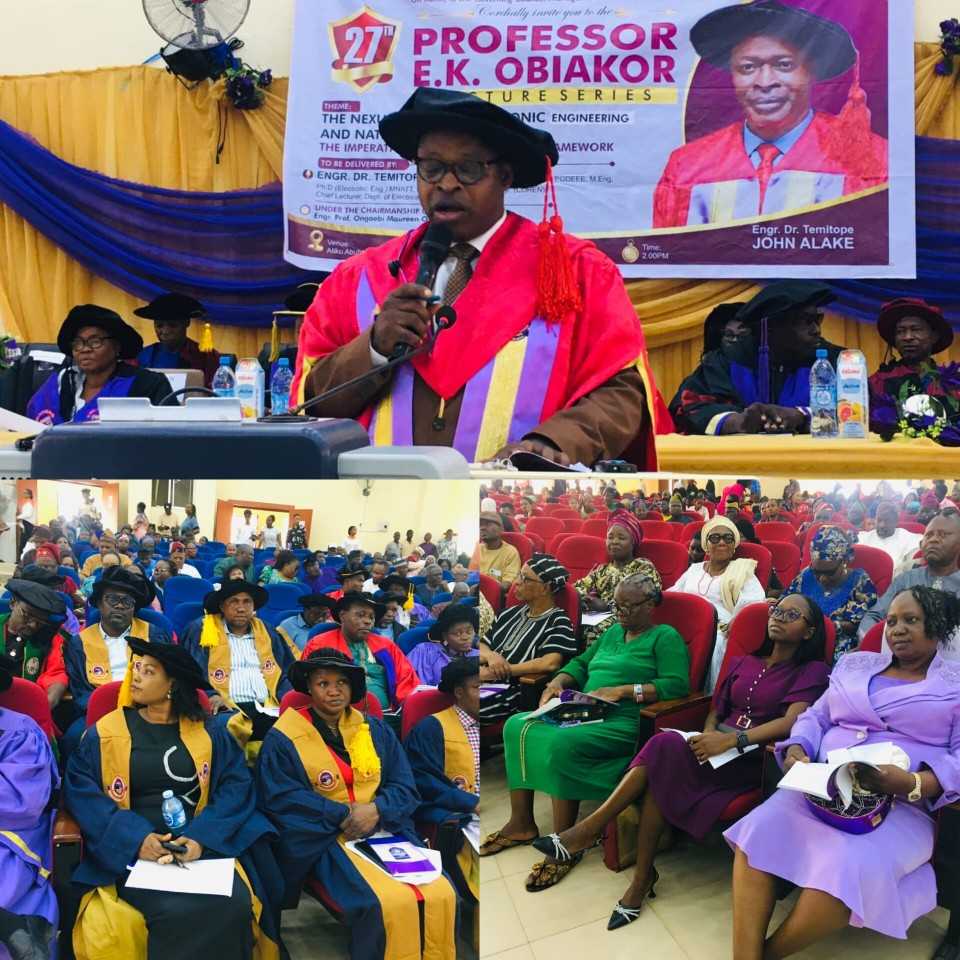
The Rector of the Federal Polytechnic, Ado-Ekiti, Dr. Temitope Alake, has called for increased government funding, supportive policies and greater private-sector investment in electronic engineering to unlock the sector’s potential to drive Nigeria’s technological and economic development.
Alake, who is also a Chief Lecturer in the Department of Electrical/Electronic Engineering, made the call while delivering the 27th Professor Edward Kanu Obiakor Lecture Series, titled, “The Nexus Between Electronic Engineering and National Development: The Imperative of Skill Qualification Framework,” at the institution.
He said Nigeria’s quest for technological advancement, economic diversification and technological sovereignty would remain difficult to achieve without deliberate investment in electronic engineering education, research, infrastructure and skills development.
According to him, government must take the lead by developing appropriate policies and funding mechanisms that will strengthen electronic engineering education and research, while creating an enabling environment for innovation and industrial investment.
He also urged the government to increase funding for Science, Technology, Engineering and Mathematics (STEM) education and research, particularly in electronic engineering, while providing incentives for stronger public-private partnerships.
Alake stressed that industrialists should complement government efforts by investing in training, research, modern equipment and professional development, as well as partnering with tertiary institutions to commercialise research findings and develop innovative technologies.
He said, “To actualise the nexus of electronic engineering and national development through effective skill frameworks, government must increase funding for STEM education and research focused on electronic engineering and incentivise public-private partnerships to co-develop curricula, internships and continuous professional development programmes.”
The Rector also advocated the development and institutionalisation of a National Skills Qualification Framework for electronic engineering, with clearly defined competency levels and learning outcomes aligned with occupational requirements.
He said such a framework would help standardise qualifications, improve employability and ensure that graduates possess skills that meet the demands of the modern industrial sector.
Alake further called for the integration of compulsory internships, apprenticeships and industry attachments into engineering education, saying students needed greater exposure to practical, real-world working environments.
He urged educational institutions to reform their curricula to accommodate emerging technologies and practical skills through project-based and experiential learning.
The Rector also encouraged industries to participate actively in curriculum development and skills validation, noting that employers were in a better position to identify the competencies required in the rapidly changing technological workplace.
He called for policies that would promote innovation, protect intellectual property, facilitate technology transfer and improve access to technological infrastructure and markets.
Alake said sustained collaboration among policymakers, educators and industry leaders was essential to building a skilled workforce and creating an electronic engineering sector capable of contributing significantly to national development.
He added that Nigeria must develop a culture of continuous learning, innovation and investment if electronic engineering is to become a major driver of technological advancement and economic growth.
