
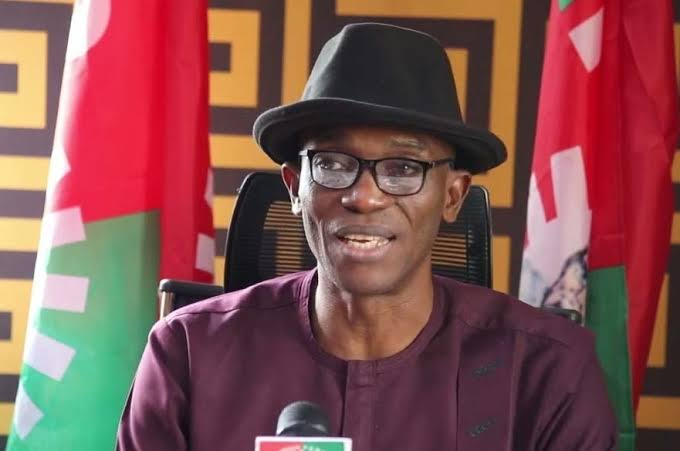
The immediate past National Chairman of the Labour Party, Julius Abure, has said he is ready to align with President Bola Tinubu or former Vice-President Atiku Abubakar in the 2027 presidential election, but will not back Peter Obi, the candidate of the Nigeria Democratic Congress.
Abure said any decision to support a candidate would depend on the outcome of a pending Supreme Court case over the leadership of the Labour Party, as well as his political interests, his ideology and how acceptable the candidate is to voters. He also vowed to mobilise his supporters against Obi, arguing that the former Anambra State governor had wasted the goodwill and political structure behind his strong showing in the 2023 presidential election.
The NDC and Obi’s camp dismissed his position, saying they had moved on from the former LP chairman and were focused on the 2027 contest.
In an exclusive interview with The PUNCH, Abure said he would consult his supporters and settle on a preferred candidate if the Supreme Court did not deliver judgment before the end of November.
Asked which of the three leading contenders he might back, he said he was waiting for the court’s decision, after which he would weigh the offer of anyone seeking his support. He said the candidate must fit his camp’s interests and ideology and be marketable to voters. Once those conditions were met, he said, his supporters, the same people who campaigned for Obi across the country in 2023, would be highly visible again.
He said he was open to working with any of the major candidates. Citing a line from former Head of State Ibrahim Babangida, he said one may know whom one will not hand over to without knowing whom one will. In the same way, he said, he was certain he would not support Obi in 2027 but was open to alignment with others.
Abure said the NDC was out of consideration because of Obi’s presence in it. He said he saw no reason to back Obi again and held that position firmly. He added that he was not yet in talks with any candidate, since the decision involved not just himself but also his followers and their interests.
He said his supporters remained loyal to the party structure he controlled, despite the exit of some members to other platforms. He accused Obi and Abia State Governor Alex Otti of undermining the party’s leadership, alleging that the structure was dismantled from the ward level to the national level. He said the people who supported Otti and the leadership he imposed on the party had done it a great disservice, and that he had been their main target.
The dispute between Abure and Obi grew out of prolonged leadership crises in the Labour Party, including disagreements over how its national convention was conducted and who controlled its organisation.
Abure accused Obi and Otti of deepening the crisis by setting up a parallel National Working Committee in Owerri. Allies of the former LP presidential candidate countered that Abure broke an earlier agreement to hold an inclusive convention starting at the ward and state levels before the national one. The disagreement widened the rift between the two camps, and Obi moved away from the Labour Party to pursue a new platform.
Abure argued that the crisis exposed weaknesses in Obi’s leadership, saying the way he handled the party was now being used to judge whether he could run the country. In his view, someone who cannot manage a small organisation cannot lead a large one.
He also criticised Obi’s move from the Labour Party to the African Democratic Congress before he joined the NDC, alleging that Obi expected to repeat the leadership struggle in his former party. According to Abure, Obi left the ADC after realising he could not get his desired outcome there, with some of his supporters staying behind and others following him to the NDC.
Asked whether Obi would enjoy in the NDC the freedom he had under his own leadership, Abure said the situation was different. He argued that the NDC’s national leader, Senator Seriake Dickson, was firmly in control and would not give up the party’s leadership. He added that Dickson had learnt from the Labour Party’s crisis and was determined to avoid a repeat.
On Obi’s prospects, Abure predicted that the former governor would perform below his 2023 showing. He said Obi had squandered his goodwill, human capital and resources, and mismanaged the gains he made in 2023. He claimed Obi’s exit from the Labour Party cost him the organisational structure and campaign machinery that helped him win more than six million votes in the last presidential election.
Responding, the spokesperson for the NDC Presidential Campaign Council, Constance Ikokwu, said the party was concentrating on issues of national importance. She told The PUNCH that Obi was fully occupied with the campaign trail and focused on leading a national effort toward the 2027 contest, which she said offered Nigerians a chance to rescue the country and change its direction. She wished Abure luck in his new ventures.
Obi’s media aide, Idris Zekeri, also said the former LP chairman was no longer relevant to the campaign’s immediate priorities. He said the camp had moved on, with the election less than 70 days away and campaigning under way.
Zekeri urged Nigerians who value equity, justice, fairness, capacity, compassion and competence to support Obi, whom he described as the best qualified candidate to move the country forward. He acknowledged that not every Nigerian would back Obi, calling such differences part of the democratic process.
He said Abure’s refusal to support Obi was driven by personal grievances rather than national interest, and that Abure should ask himself why he was placing personal sentiment above the country’s good. He added that the camp was not discussing Abure, who he said was not critical to its current work.
