
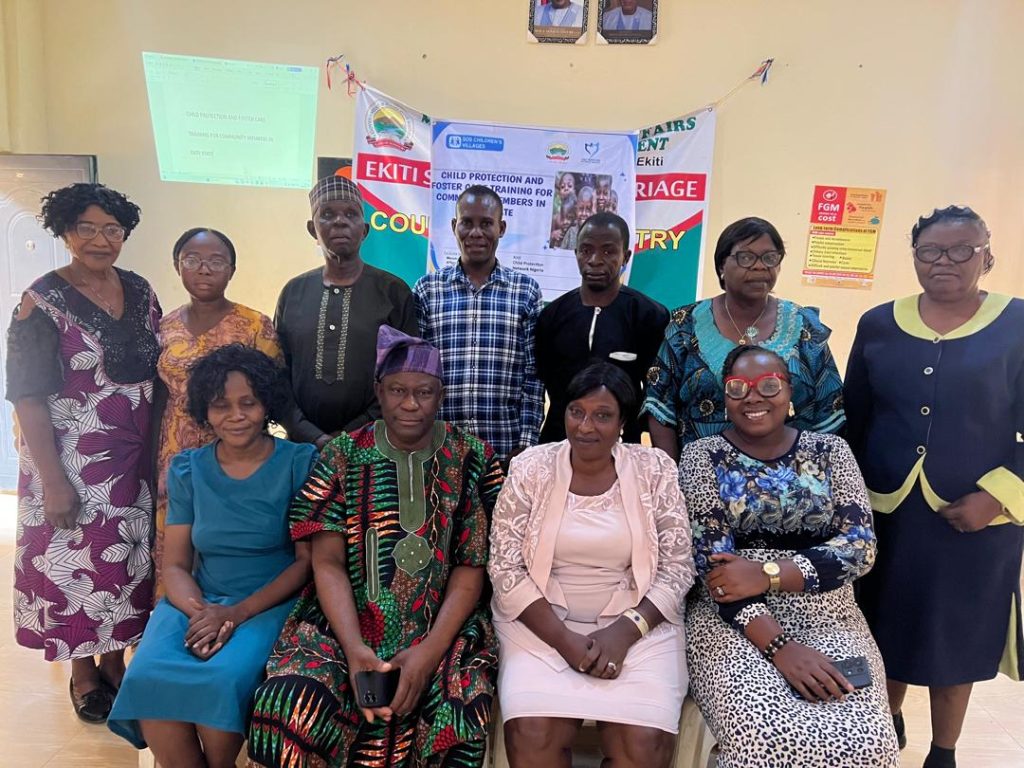
The Ministry of Women Affairs and Social Development, Ekiti State, and the Child Protection Network with funding supported from SOS Children’s Villages, Nigeria have conducted a special training programme for intending foster parents ahead of the full implementation of the Alternative Care for vulnerable children in the state.
The exercise, which was held at the state secretariat, Ado Ekiti, was supported by SOS Children’s Villages, Nigeria.
In her welcome address, CPN State Coordinator, Oluwatimileyin Adeze, explained that the exercise was designed to engage the community on the procedures of fostering a child and the necessary steps to ensure that the purpose for the introduction of the idea was achieved.
News Alert…
NO MALTREATMENT OF FOSTER CHILDREN, EKSG, CPN WARN FOSTER PARRNTS DURING TRAINING
Addressing the participants, the Zonal Coordinator of Child Protection Network, Dr. Peter Akosile, warned the intending foster parents against discrimination, maltreatment, and abuse of foster children, saying culprits would be sanctioned.
Delivering a lecture to the participants, the Director, Child, Ministry of Women Affairs, Taiwo Adalumo, explained that the introduction of alternative care for children was part of efforts by the government to promote family-based care and ensure proper upbringing of vulnerable children in alignment with UN standards.
She explained that before anyone could be allowed to foster a child, such a parent must be at least 25 years old, must be 21 years older than the child to be fostered, must have high moral character and proven integrity, must have no criminal record – especially a crime involving child abuse and neglect, must have a steady and permanent source of income to adequately meet the needs of the family, among others.
According to her, the foster parent is to ensure provision of reproductive health education to the child, support the spiritual development of the child in accordance with the wishes of the child, support the reunification of the child with the parent, guardian, or relative at an appropriate time, inform the parent, guardian, or relative about significant events or developments in the life of the child, respect and keep confidential information given by the Department/Agency about the child and his/her parents, guardian, or relatives.
Others are: nurture, care, clothe, educate, continually supervise, and assist the foster child to obtain life skills and experiences suited to the child’s developmental needs, ensure the child is provided with meals that are nutritionally balanced and that special dietary provisions or requirements, where necessary, are met.
The foster parent is also to make sure that the child receives medical attention when sick, including providing initial basic care at home, use constructive alternative methods of discipline (positive discipline methods) while avoiding the use of corporal punishment, deprivation of meals or monetary allowances, threat or removal or any type of degrading or humiliating forms of punishment.
In their responses, the participants described the exercise as educative and promised to keep to the laid-down rules if eventually assigned a child.
